.webp)

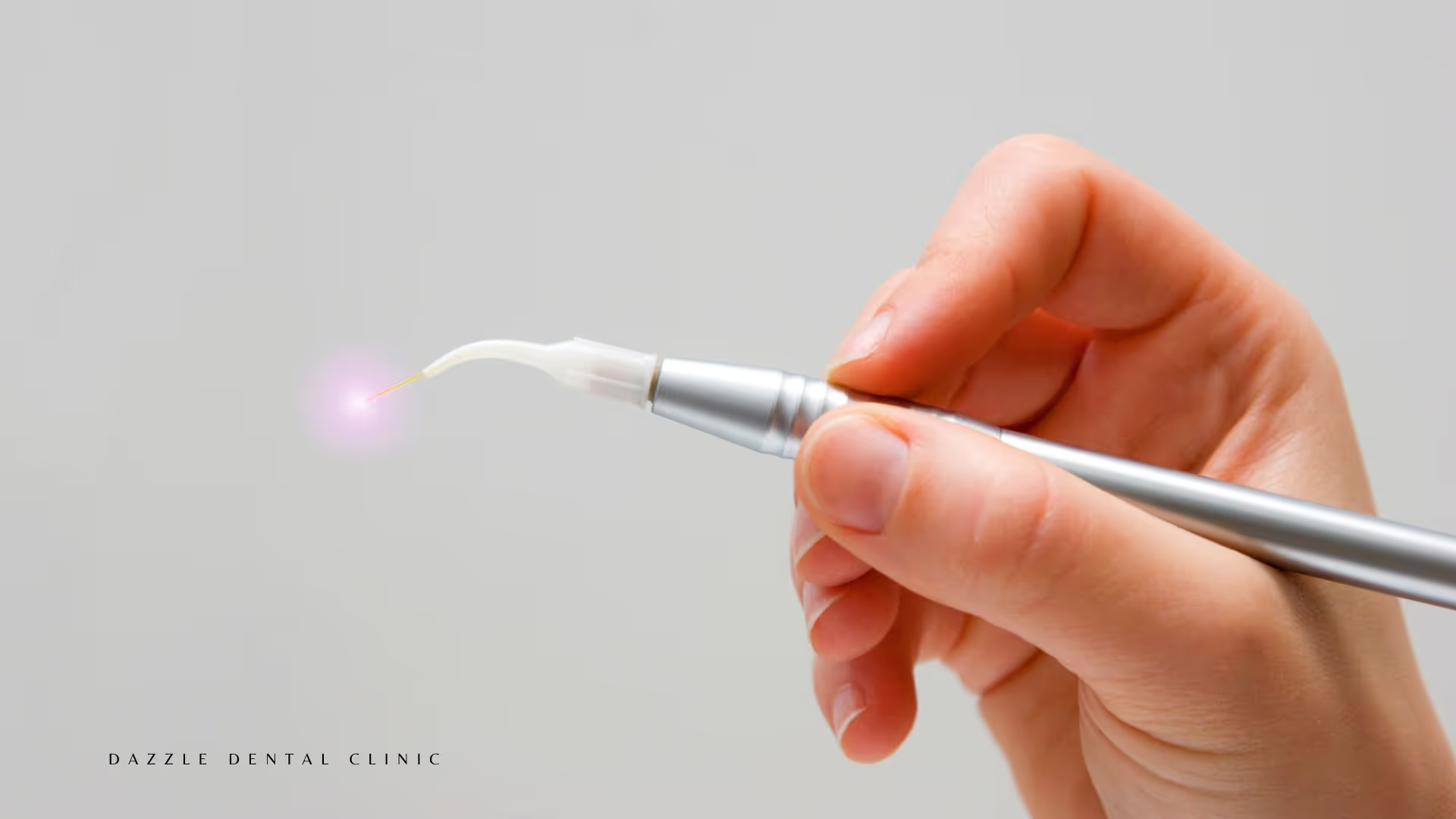
Laser-assisted dental surgery is not a synonym for painless dentistry or a marketing category. It is a specific set of clinical tools with documented advantages in particular applications — tissue precision, haemostasis, bacterial decontamination, and accelerated wound healing — that make them superior to conventional instruments for the procedures they are suited for. At Dazzle Dental Clinic, the Fotona laser system (Er:YAG and Nd:YAG wavelengths) is integrated into periodontal, soft tissue, endodontic, and cosmetic surgical procedures where its properties produce clinically better outcomes than scalpel or drill alone.
Why Laser Wavelength Determines Clinical Application
Different laser wavelengths interact with tissue differently based on their water and chromophore absorption characteristics.
Er:YAG (2940nm): Absorbed primarily by water. Ablates hard tissue (enamel, dentine, bone) and soft tissue with high precision and minimal thermal spread to adjacent structures. Used for: gingival contouring, frenectomy, crown lengthening (soft tissue phase), implant site decontamination, soft tissue management around implants, and apical surgery. The Er:YAG does not penetrate deeply into tissue — its action is surface-specific.
Nd:YAG (1064nm): Absorbed by melanin and haemoglobin. Penetrates deeper into tissue and has strong haemostatic and bactericidal effects. Used for: sub-gingival pocket decontamination in periodontal therapy, peri-implantitis decontamination, and stimulation of tissue regeneration via photobiomodulation.
Periodontal Applications
In active periodontal disease management, the Nd:YAG is used as an adjunct to scaling and root planing. The laser is passed through the periodontal pocket after mechanical debridement to decontaminate the pocket walls and subgingival surfaces. Studies have shown that laser-assisted periodontal therapy achieves greater pocket depth reduction and clinical attachment gain compared to scaling and root planing alone in deep pockets (6mm+). The bactericidal effect specifically targets gram-negative anaerobic bacteria — the pathogens responsible for progressive bone loss in periodontitis.
For gingival contouring — reshaping the gum line to correct asymmetry, reduce gummy smile display, or improve the proportions of anterior teeth — the Er:YAG provides clean tissue removal with minimal bleeding and no sutures required in most cases. Healing is noticeably faster than scalpel gingivectomy.
Frenectomy
Laser frenectomy (Er:YAG) is the standard approach at Dazzle for labial and lingual frenula release. Compared to scalpel frenectomy: no sutures required, minimal bleeding, significantly reduced post-operative discomfort, and faster healing. For the full frenectomy clinical guide, see our dedicated frenectomy article.
Implant and Peri-Implantitis Applications
Peri-implantitis decontamination with the Nd:YAG is an adjunct to mechanical debridement of the implant surface. The laser’s bactericidal effect penetrates the rough implant surface micro-topography that mechanical instruments cannot fully reach. Used at Dazzle as part of the peri-implantitis treatment protocol alongside open flap debridement for moderate-to-severe cases.
For soft tissue management at the time of implant second-stage surgery, the Er:YAG excises the healing tissue over the implant precisely, without bleeding, and without the need for sutures — allowing a clean abutment connection procedure and minimal patient discomfort.
Microsurgical Precision: Dental Microscopes
Dental operating microscopes are used at Dazzle for endodontic treatment, root-end surgery (apicoectomy), and preparation margin verification on ceramic restorations. The microscope provides 8–25× magnification, allowing accurate identification of canal anatomy, isthmi, and cracks that are not visible to the naked eye. For apicoectomy, microsurgical technique with ultrasonic root-end preparation and MTA or bioceramic retrofill achieves 85–95% healing at 2–4 years in published literature.
FAQs
Q1: Is laser gum contouring permanent?
For cases where the excess tissue is purely gingival (the bone is at the correct level), laser contouring is permanent — the tissue does not regenerate. For cases where gum excess is due to a high bone crest, laser contouring alone produces temporary results; the tissue regrows because the underlying bone position drives the gum level. These cases require osseous crown lengthening for a stable result.
Q2: Is laser treatment painful?
For gingival procedures, the Er:YAG typically requires only topical anaesthetic, not injections. For deeper periodontal pocket decontamination and frenectomy in adults, local anaesthetic is standard. Most patients find laser procedures significantly more comfortable than equivalent scalpel procedures and recover faster with less post-operative pain.
Q3: Is laser treatment suitable for children?
Yes. Laser frenectomy for infants and children is the preferred approach at Dazzle for tongue and lip tie releases due to its precision, minimal bleeding, and no-suture technique. For older children requiring gingival contouring or soft tissue procedures, the same Er:YAG protocol applies.
Q4: How does a dental microscope improve root canal treatment outcomes?
Root canals contain anatomical complexity — additional canals, isthmi connecting canals, calcified or curved canals — that standard illumination misses. Under microscope magnification, these structures are identifiable and can be cleaned and shaped correctly. Missed canals are among the most common causes of root canal treatment failure and the need for retreatment.