.webp)

Treatment success in implant dentistry and complex restorative cases is not determined solely by the surgical or clinical procedure. The prosthetic component — the crown, bridge, or full-arch restoration that attaches to the implant or sits on the prepared tooth — must meet specific fit and functional criteria for long-term outcomes to match the surgery quality. This is where an in-house digital laboratory with a direct clinical-laboratory workflow makes a measurable difference.
Dream Dental Studio is Dazzle Dental Clinic’s integrated CAD/CAM laboratory. Its role in treatment success is specific and documentable: it improves the precision of prosthetic fit, compresses delivery timelines, and allows real-time adjustment without external laboratory cycles. Here is what this means for specific treatment types.
Implant-Supported Single Crowns
An implant-supported crown must achieve accurate marginal fit at the implant-abutment interface and correct occlusal contacts in all jaw movements. Custom abutments designed from the TRIOS 5 intraoral scan match the implant position, the emergence profile through the gingival tissue, and the crown margin location at the gingival level. Stock abutments are manufactured to a universal geometry and do not achieve this match at all anatomical positions.
At Dream Dental Studio, custom titanium or zirconia abutments are milled from the digital data for each case. The crown is then designed against the custom abutment geometry and milled in E.max CAD (anterior) or zirconia (posterior). The assembled restoration is delivered with the correct emergence profile, which maintains peri-implant tissue health by preventing biofilm accumulation in the gingival sulcus. This is a long-term maintenance outcome — not immediately visible but clinically significant at the 5–10 year review. For more on how the digital workflow operates, see our in-house digital lab article.
Full-Arch Implant Bridges (All-on-4 / All-on-6)
Passive fit is the critical prosthetic parameter for full-arch implant bridges. When a bridge is placed across four or six implants, it must seat simultaneously on all implants without generating stress at any implant neck. Misfit above approximately 150 microns creates chronic mechanical stress at the bone-implant interface and is associated with marginal bone loss and implant failure over time.
Achieving passive fit requires: an accurate digital model of the implant positions from the intraoral scan; a CAD bridge design that accounts for the implant positions with no positional assumptions; and milling from solid material blocks rather than layered or joined sections that may shrink or distort. Dream Dental Studio’s workflow achieves all three. The provisional bridge for same-day delivery is pre-fabricated from pre-surgical digital scans and mounted on analogue implant replicas; the final monolithic zirconia bridge is fabricated from the post-surgical impression or scan taken when the soft tissue has settled.
Multi-Veneer Smile Cases
Multi-veneer cases require shade consistency across adjacent restorations that is virtually impossible to achieve from separate external laboratory orders. The technician who characterises a six-veneer case at Dream Dental Studio works from a single clinical reference — a shade photograph taken under natural light by the treating clinician alongside the patient. The characterisation of each veneer’s surface texture, translucency gradient, and gingival shade transition is applied consistently across the set because the same technician completes all six pieces in the same session.
When this work is sent to an external laboratory, it is completed by whichever technician is available, under whatever lighting conditions exist in that laboratory, from a written shade note. The result is rarely as consistent as in-house direct-communication fabrication.
Surgical Guides
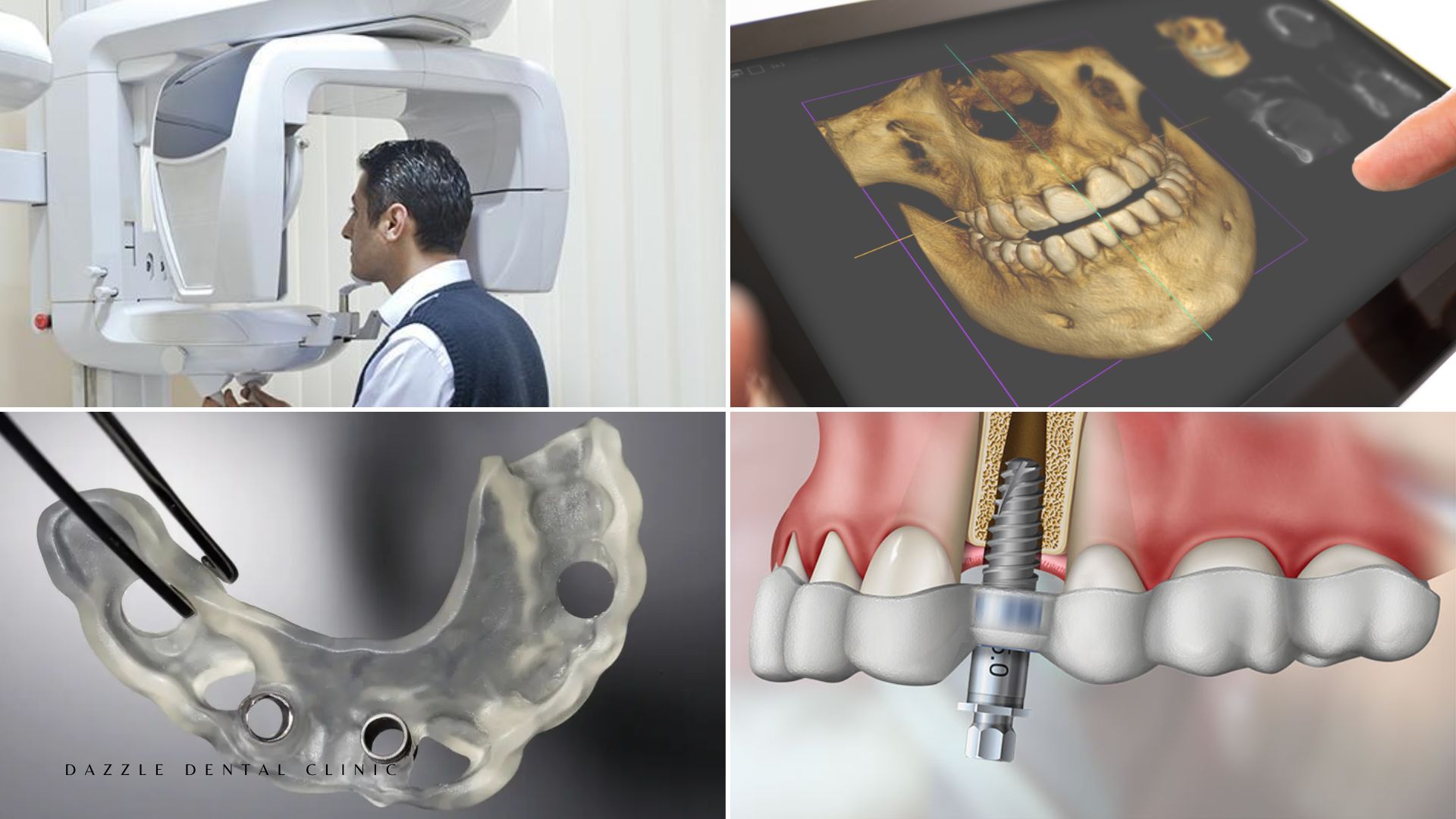
3D-printed surgical guides for implant placement are fabricated at Dream Dental Studio from the CBCT data and virtual surgical plan. The guide constrains the drill to the planned position within under 1mm apex deviation and under 2° angular deviation from the plan. This precision is what allows implants to be placed in the position the prosthodontist designed the prosthesis around, rather than adapting the prosthesis to where the implants ended up.
FAQs
Q1: What is passive fit and why does it matter for my implants?
Passive fit means the bridge seats on all implants simultaneously without requiring the implants to flex or the bone to deform. When a bridge does not achieve passive fit, it applies chronic mechanical stress to the implant necks every time the patient bites. Over years, this stress causes marginal bone loss around the implants — the leading cause of late implant failure after peri-implantitis.
Q2: Can I see the laboratory while I’m being treated at Dazzle?
Yes. Dream Dental Studio operates in the same building as the clinical areas. Patients who are curious about the fabrication process are welcome to see the milling unit, sintering furnace, and 3D printer. For complex aesthetic cases, the treating clinician brings the patient directly to the laboratory for shade assessment with the technician present.
Q3: Does the in-house laboratory handle all restorations, or are some sent externally?
The vast majority of restorations are fabricated in-house. Gold onlays, which require casting rather than milling, are the primary category fabricated externally via a specialist casting laboratory. Complex hand-layered feldspathic cases that require extensive manual porcelain layering may also involve external specialist ceramists for cases where the aesthetic demand exceeds what is achievable within the time constraints of an in-house workflow.
Q4: How does the digital workflow handle shade matching for tooth-coloured restorations?
Shade matching at Dazzle involves: VITA shade guide assessment under natural light conditions; intraoral shade photographs calibrated to a reference tab; and for complex anterior cases, direct assessment by the laboratory technician alongside the treating clinician. The TRIOS 5 scanner captures surface colour data that informs the milling block selection. Final characterisation is applied by hand by the technician after the initial milling is complete.