.webp)

Same-day teeth — leaving an implant surgery appointment with a fixed provisional bridge in place — is achievable for most All-on-4 and All-on-6 patients and is the standard protocol at Dazzle Dental Clinic. But it is not guaranteed for every patient, and the provisional bridge placed on surgery day is not the final result. Understanding what immediate loading actually involves prevents the disappointment that comes from expecting a finished smile the day of surgery.
The Biology Behind Immediate Loading
Osseointegration — the biological bonding of titanium to bone — requires undisturbed healing. Micro-movement at the implant-bone interface above approximately 100–150 microns disrupts this process and leads to fibrous encapsulation (implant failure) rather than bone integration. Immediate loading is safe because the implant’s primary mechanical stability at placement is sufficient to keep micro-movement below this threshold under controlled provisional loading. The provisional bridge distributes forces across all implants simultaneously, reducing the load at any individual implant fixture during healing.
Primary stability is measured intraoperatively by insertion torque (the resistance the implant threads generate in bone during placement). The threshold for immediate loading: approximately 35 Ncm. Below this, the implant is left unloaded until osseointegration provides biological stability. Above this, loading proceeds.
What Determines Whether a Patient Qualifies for Same-Day Loading
Bone density: Dense bone (Misch Type I–II) achieves high insertion torque reliably. Soft bone (Type III–IV in the posterior maxilla) may not reach threshold with standard implant systems — which is why Nobel Active and MegaGen AnyRidge (active thread designs with aggressive geometry for soft bone engagement) are used for these sites at Dazzle. For detail on how these systems are selected, see our implant system selection guide.
Intraoperative measurement: Candidacy is confirmed on surgery day, not at consultation. The surgeon measures insertion torque at each implant as it is placed. If thresholds are met at all four (or six) sites: loading proceeds. If one site falls below threshold, the surgeon pivots to an alternative position, a wider implant, or stages that site for delayed loading. This intraoperative protocol is explained during informed consent.
Risk factors for reduced stability: Uncontrolled diabetes, active smoking, severe bruxism, and certain bone-metabolic medications increase the risk that threshold torque will not be achieved or that osseointegration will be compromised. These are assessed at medical history review before surgery is planned.
The Provisional Bridge vs the Final Prosthesis
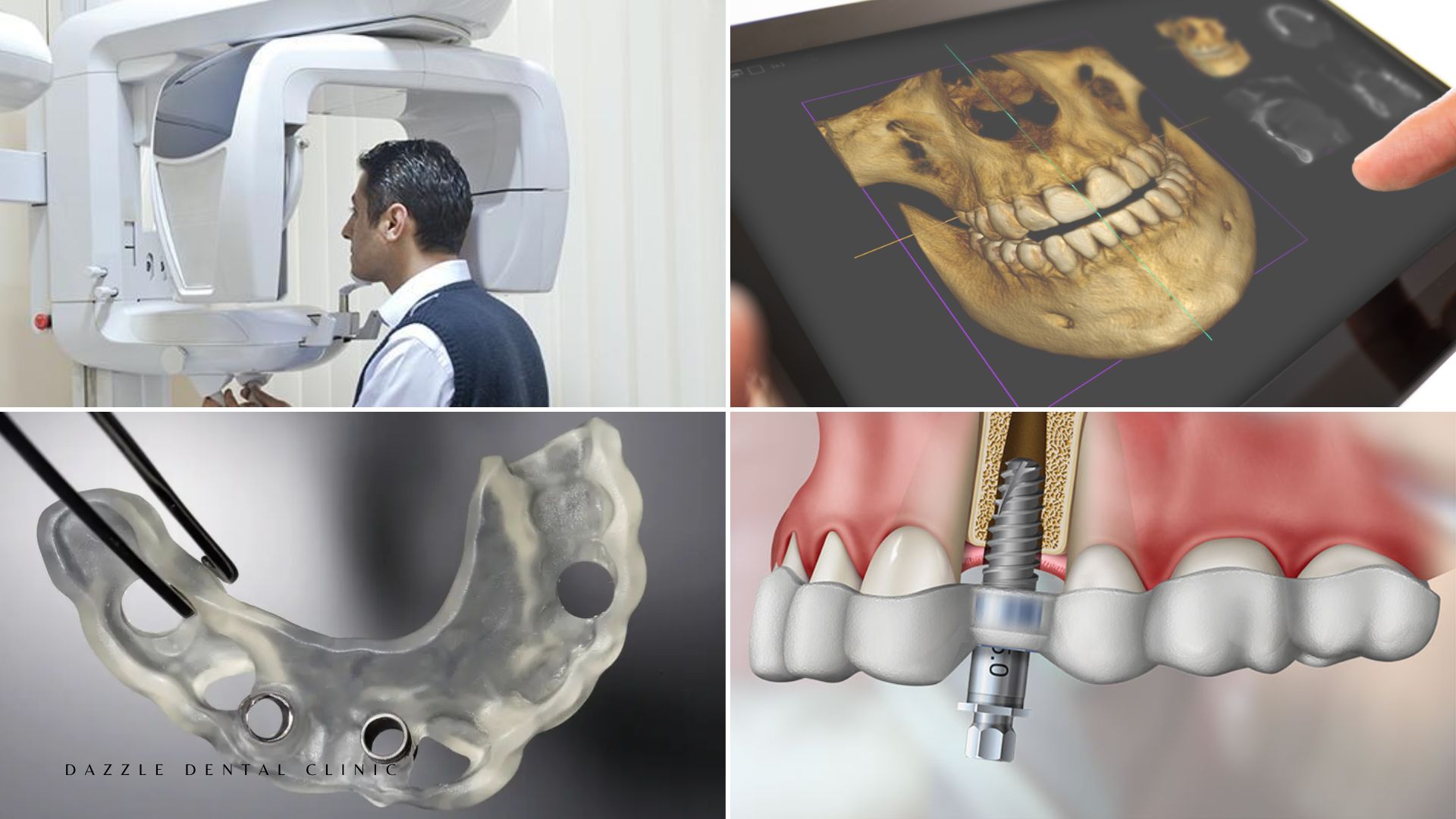
The provisional bridge placed on surgery day is an acrylic or PMMA bridge — fabricated in the in-house laboratory before surgery from pre-surgical digital scans, and placed within the surgical appointment after implant placement. It is functional: the patient eats soft foods from the first day. It is not the final result.
The final monolithic zirconia bridge is fabricated at 3–6 months after osseointegration is confirmed by ISQ measurement and periapical radiograph. It is designed from a new intraoral scan of the integrated implants, reviewed and approved by the patient at try-in, and permanently screwed into place. This is the restoration designed to last 15–20 years.
Surgery Day and Recovery
Full-arch surgery (implant placement + provisional bridge placement): 3–5 hours. Local anaesthesia with conscious sedation (patient preference). Post-operative swelling peaks at 48–72 hours and resolves over 7–10 days. Soft diet for 6–8 weeks. Daily water flossing under the bridge and twice-daily brushing from Day 1. For international patients: minimum Day 5–6 post-surgery before long-haul travel is recommended; fitness-to-fly assessment provided by the clinical team before departure.
FAQs
Q1: Will I definitely receive same-day teeth at Dazzle?
In the majority of planned All-on-4 and All-on-6 cases, yes. Eligibility is confirmed intraoperatively. The contingency protocol (staged loading) is discussed at consultation so patients understand what happens if thresholds are not met. It is not guaranteed unconditionally.
Q2: What can I eat after surgery?
Day of surgery: clear liquids. From Day 1 evening: soft foods (yoghurt, soft rice, soup, scrambled eggs). For 6–8 weeks: no hard, crunchy, or chewy foods. After final bridge delivery: normal diet. Hard foods (ice, hard breads, hard nuts) are advised against long-term for any implant prosthesis.
Q3: How is the provisional different from the final bridge?
The provisional is a functional temporary — designed for light loading during osseointegration. The final zirconia bridge is fabricated from the integrated implant positions, designed for full occlusal load, patient-approved at try-in, and intended as the permanent restoration. The provisional protects the implants; the final bridge is the clinical endpoint.
Q4: For international patients: how are the two visits structured?
Visit 1 (5–7 days): Assessment, CBCT confirmation, surgery, provisional placement, post-surgical review. Visit 2 (3–4 days at 3–6 months): Osseointegration confirmation, intraoral scan, zirconia bridge fabrication and delivery. The in-house laboratory allows the final bridge to be designed, milled, and delivered within the same visit window.